Friday, 14 August 2015

RAO TRAVEL- JAY HIND

India got independence on 15th of August in 1947 from the clutches of British rule. Indian people all over the country celebrate this national festival annually with lots of joy and enthusiasm. It was great day for all the Indian citizens when India’s tricolor flag was unfolded by the first Prime Minister of India, Pandit Jawahar Lal Nehru, at the Red Fort, Delhi.
A huge celebration takes place in New Delhi at Rajpath every year where national anthem is sung after the flag hoisting by prime minster. Together with the national anthem a salute through 21 guns firing and showering of flowers through helicopter is given to the national flag. Independence day is a national holiday however everyone celebrate this from their own places by hosting the flags in schools, offices or society. We should feel proud to be an Indian and try our best to save the honor of our country.

Tuesday, 11 August 2015

RAO TRAVEL- Mussoorie

Mussoorie perched in Uttarakhand, is famed as the “Queen of Hills”. It is an extremely beautiful hill station to explore. While glaring over Dehradun, Mussoorie provides the “déjà-vu” missing out in one’s life. An evening walk on the Mall Road is enough to entangle you to get “relocated to Mussoorie” and cherish long-lasting memories.  Flooded with many top boarding schools of India, Mussoorie is a tourist and education hub of Uttarakhand . The beauty of the hills has even captivated the celebrated writer like Ruskin Bond. The travel destinations near Mussoorie are Dhanaulty, Dehradun, Rishikesh and so on.


Monday, 10 August 2015

RAO TRAVEl - Lambasingi

Lambasingi (or Lammasingi) is a small village in the Chintapalli Mandal of Vishakapatnam district of Andhra Pradesh, India. It is situated in the agency area. This place is often referred as Kashmir of Andhra Pradesh. The temperatures in this places go as low as 0 °C in December – January). This village is situated at a height of above 1000 meters from the sea level.This is the only place in South India where snowfall occurs. 
Another name for this Lambasingi village is Korra Bayalu. Korra means ´stick´, Bayalu means ‘outside’, in the local language this means “if some one stays outside the house in the open they will freeze like a stick”.
In the state of Andhra Pradesh Adilabad and Arogyavaram are couple of places that record lowest temperatures. Lammasingi records less than 5 °C even in seasons other than winter. You can see sun only after 10 am on any given day and in winters only around 12 but again by 3pm this place will be blanketed by thick fog.


Sunday, 9 August 2015

RAO TRAVEL - DIVALI FESTIVAL OF GUJARAT

Deepawali or Diwali is certainly the biggest and the brightest of all Hindu festivals. It's the festival of lights (deep = light and avali = a row i.e., a row of lights) that's marked by four days of celebration, which literally illumines the country with its brilliance, and dazzles all with its joy. Each of the four days in the festival of Diwali is separated by a different tradition, but what remains true and constant is the celebration of life, its enjoyment and goodness.

The Origin of Diwali


Historically, the origin of Diwali can be traced back to ancient India, when it was probably an important harvest festival. However, there are various legends pointing to the origin of Diwali or 'Deepawali.' Some believe it to be the celebration of the marriage of Lakshmi with Lord Vishnu. Whereas in Bengal the festival is dedicated to the worship of Mother Kali, the dark goddess of strength. Lord Ganesha, the elephant-headed God, the symbol of auspiciousness and wisdom, is also worshiped in most Hindu homes on this day. In Jainism, Deepawali has an added significance to the great event of Lord Mahavira attaining the eternal bliss of nirvana. Diwali also commemorates the return of Lord Rama along with Sita and Lakshman from his fourteen year long exile and vanquishing the demon-king Ravana. In joyous celebration of the return of their king, the people of Ayodhya, the Capital of Rama, illuminated the kingdom with earthendiyas (oil lamps) and burst crackers.


Saturday, 8 August 2015

RAO TRAVEL- DIAMONAD CITY SURAT

Surat is connected with diamond business since ancient time, Surat is a city located on the western part of India in the state of Gujarat. Surat is one of the cleanest city of India and is also known by several other names like "THE DIAMOND CITY”, "THE SILK CITY", etc. It has the most vibrant present and an equally varied heritage of the past. It is the city where the British first landed in India. The Dutch and the Portuguese also established their business centers in Surat, the remnants of which are still preserved in the modern day Surat. In past this was a glorious port with ships of more than 84 countries anchored in its harbour at any time. Today, 92% of the world's diamonds are cut and polished in surat.


RAO TRAVEL- TEXTILE INDUSTRY AHMEDABAD

The textile industry of the city of Ahmedabad in the state of Gujarat in India dates back to the 19th century, when the city and the industry was established under the British Raj. Textile mills employed thousands of people from across the state, and the cotton garments manufactured were exported across the world. The prosperity of the industry was the mainstay of the city's economy. It is called the Manchester of India.
The Arvind Mills is a company that processes denim for jeans worldwide, it is located near the Sabarmati river; as such the water required for the textile industry is easily available. The black soil found abundantly in Gujarat is best suited for the cultivation of cotton which is mostly required for the industry. and black soil is found in Maharashtra also.
Another major company in Ahmedabad is Ashima group. Electricity and cheap labour are available in abundance. Ahmedabad stands very near to the sea and as such export and import becomes easy.


RAO TRAVEL - DOMESTIC EMBROIDERY


he economic conditions of the Reagan years, coupled with tax incentives for home businesses, helped propel Melco to the top of the market. At the Show of the Americas in 1980, Melco unveiled the Digitrac, a digitizing system for embroidery machines. The digitized design was composed at six times the size of the embroidered final product. The Digitrac consisted of a small computer, similar in size to a BlackBerry, mounted on an X and Y axis on a large white board. It sold for $30,000. The original single-needle sample head sold for $10,000 and included a 1" paper-tape reader and 2 fonts. The digitizer marked common points in the design to create elaborate fill and satin stitch combinations.
Melco patented the ability to sew circles with a satin stitch, as well as arched lettering generated from a keyboard. An operator digitized the design using similar techniques to punching, transferring the results to a 1" paper tape or later to a floppy disk. This design would then be run on the embroidery machine, which stitched out the pattern. Wilcom enhanced this technology in 1982 with the introduction of the first multi-user system, which allowed more than one person to work on the embroidery process, streamlining production times.


RAO TRAVEL- APPLIQUE

Appliqué is a decorative surface design technique that adds dimension and texture to the background fabric. The term derives from the French word appliquer (and the Latin applicare) that means to join or attach. While its early use was most likely to strengthen worn areas or serve as a patch over holes, appliqué developed into a creative art form used by many cultures over many centuries.


Monday, 3 August 2015

NALSAROVAR

Kutch has many varieties of places; by geographical positions and surroundings of nature as well as the ancient Historical buildings. Bhuj is main Capital City of the Kutch and its connects you to a range of civilizations and important events in South Asian history through prehistoric archaeological finds, remnants of the Indus Valley Civilizations (Harappans), places associated with Mahabharata and Alexander the Great’s march into India and tombs, places and other buildings from the rule of the Naga Chiefs, the Jadeja Rajputs, the Gujarat Sultans and the British Raj.

NARAYAN SAROVAR:

Situated at the western most tip of India, Narayan Sarovar Lake is one of the 5 holy lakes, along with Mansarovar in Tibet, Pampa in Karnataka, and Bhubaneswar in Orissa and Pushkar in Rajasthan.

Sunday, 2 August 2015

Rao Travel - White kutch rann Introduction

The Rann of Kutch, an area of 18,000 sq km, lies almost entirely within Gujarat along the border with Pakistan. The Little Rann of Kutch extends northeast from the Gulf of Kutch over 5,100 sq km. Once an extension of the Arabian Sea, the Rann ("salt marsh") has been closed off by centuries of silting. During Alexander's time it was a navigable lake, but is now an extensive mudflat, inundated during the monsoons, salty and cracked otherwise. Settlement is limited to low, isolated hills. 
When I visited the Rann in April, 2006, the highs were already soaring past 110 F. The best way to see it, as I did, is in a 4WD stocked with lots of water. Dotting the parched landscape are desolate desert-like encampments, where a family or two combine forces to eke out a living by mining salt from the saline ground water, the biggest local industry. Legend has it that even after a salt worker dies and is cremated, the soles of his feet survive - a lifetime of labor in the salt pans bakes them so hard that even fire cannot fully burn them.* Tata lorries transport their salt to small trading villages along a railway line. In the dry season, such villages host veritable hillocks of salt as far as the eye can see, where it's packed and sent out on trains.
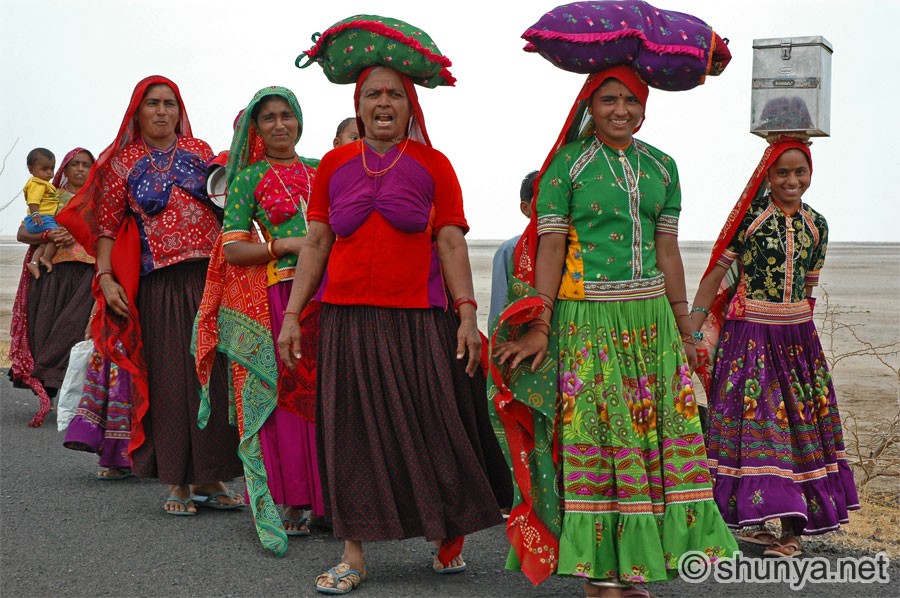
Kutch is also home to numerous tribal groups, whose attire often adds a dash of color to the otherwise dull desert monotones. Many, such as the Rabari, are still nomadic and semi-nomadic pastoralists (these photos only show women, children, and older men with the camels; the younger men were out tending their sheep and would converge in the evening at a designated place, where the women would setup the tents and cook).
In the monsoons, parts of the Rann fill up with seasonal brackish water and some locals harvest shrimp in it. They abandon their boats afterwards in the barren salty mudflats, creating a rather surreal scene for the spring/summer-time visitor. Heat mirages abound, making distant objects hover strangely above the land. The Little Rann is also a wildlife sanctuary that protects the Asiatic wild ass, a shy and handsome animal that can sprint at 70 km/h. Down to about 2,800 in number, they depend on the few grassy islands, or bets, nourished by monsoon rains. The sanctuary also contains a large number of local and migratory birds, especially flamingos, at its many wetlands. A memorable experience was to go wading knee-deep into the warm waters of a salt marsh with thousands of flamingos around.             

Rao Travel - White kutch ran Introduction

The Rann of Kutch, an area of 18,000 sq km, lies almost entirely within Gujarat along the border with Pakistan. The Little Rann of Kutch extends northeast from the Gulf of Kutch over 5,100 sq km. Once an extension of the Arabian Sea, the Rann ("salt marsh") has been closed off by centuries of silting. During Alexander's time it was a navigable lake, but is now an extensive mudflat, inundated during the monsoons, salty and cracked otherwise. Settlement is limited to low, isolated hills.
When I visited the Rann in April, 2006, the highs were already soaring past 110 F. The best way to see it, as I did, is in a 4WD stocked with lots of water. Dotting the parched landscape are desolate desert-like encampments, where a family or two combine forces to eke out a living by mining salt from the saline ground water, the biggest local industry. Legend has it that even after a salt worker dies and is cremated, the soles of his feet survive - a lifetime of labor in the salt pans bakes them so hard that even fire cannot fully burn them.* Tata lorries transport their salt to small trading villages along a railway line. In the dry season, such villages host veritable hillocks of salt as far as the eye can see, where it's packed and sent out on trains.
Kutch is also home to numerous tribal groups, whose attire often adds a dash of color to the otherwise dull desert monotones. Many, such as the Rabari, are still nomadic and semi-nomadic pastoralists (these photos only show women, children, and older men with the camels; the younger men were out tending their sheep and would converge in the evening at a designated place, where the women would setup the tents and cook).
In the monsoons, parts of the Rann fill up with seasonal brackish water and some locals harvest shrimp in it. They abandon their boats afterwards in the barren salty mudflats, creating a rather surreal scene for the spring/summer-time visitor. Heat mirages abound, making distant objects hover strangely above the land. The Little Rann is also a wildlife sanctuary that protects the Asiatic wild ass, a shy and handsome animal that can sprint at 70 km/h. Down to about 2,800 in number, they depend on the few grassy islands, or bets, nourished by monsoon rains. The sanctuary also contains a large number of local and migratory birds, especially flamingos, at its many wetlands. A memorable experience was to go wading knee-deep into the warm waters of a salt marsh with thousands of flamingos around.             

RAO TRAVEL- HERITAGE PLACES AT KUTCH

Aaina Mahal - Bhuj

This is a beautiful museum, built in the 18th century as the palace of Maharao Lakhpatji. It has a Hall of Mirrors with white marble walls covered with mirrors and gilded ornaments; the floor is lined with tiles with a platform above it surrounded by a series of fountains. The room also has a chandelier of Venetian glass. It lies in the old part of the city, in a small, fortified courtyard and houses some very rare idols.


Prag Mahal - Bhuj

Constructed in 1979, the Prag Mahal is a magnificent building made of ornate Italian marble and sandstone. Its Corinthian pillars and Jali work depicting European flora and fauna are worth observing.


Hodka - Cultural Heritage of Kutch

Hodak cultural village is situated in the Kutch District of Gujarat. Hodka is 53 kms. from Bhuj towards Khavada. Hodka is located in the Banni Grassland, right on the edge of the great salt desert - the Rann. The village is a cluster of houses situated close to each other. 7 to 8 families live in a cluster. The village is famous for its craft like Decorative Mirrors, Lamps, Hand Fans, Letter Boxes, Wall Hanging, Lather, Clay, Wood, Metal and Mud work especially the exquisite silver jewellary. The artisans sell their goods directly from their artistic huts which are popularly known as Bhungas.

Accommodation at Shaam-e-Sarhad, Hodka:
Tents and traditional Bhungas, both with attached bathrooms and running hot and cold water.  Traditional food is served.

Other services like pickup and drop facilities to and from Bhuj, local guides available.

Saturday, 1 August 2015

RAO TRAVEL-Wildlife

link-http://www.raotravelservices.com/wild.htm

Wildlife Safari In Gujarat

Gujarat is the land of the Asiatic lion and the Indian wild ass not seen elsewhere. It also has thriving populations of leopard, sloth bear, wolf, blackbuck and other mammals. Smaller mammals can be seen in the Rann of Kutch and Banni.
India’s first Marine National Park runs along the coastline of the Gulf of Kachch offering opportunities to see marine invertebrate and a variety of fish.
One of India’s most prolific areas for birdwatching, Gujarat’s wetlands attract huge congregations of birds in numbers beyond comprehension. For birders, globally-threatened species of vulture, great Indian bustard, grey hypocolius, white-naped tit, stolicza’s bushchat, are among the many interesting species to be seen. Raptors abound in the Banni grasslands and the harrier roost at Velavadar National Park is one of the world’s largest.
For herpetologists, spiny-tailed lizard can be a major attraction in the Kutch region. 


tour package by -Rao Travels
link-http://www.raotravelservices.com/

10 Nights - 11 Days
Day-1: AHMEDABAD – DASADA
Arrive Ahmedabad and drive to Dasada. Late-afternoon safari in the Little Rann of Kutch, a sanctuary for the endangered Asiatic Wild Ass. the mammals of the Rann other than the wild ass, there are chances of seeing nilgai, chinkara gazelle, white-footed desert and Indian foxes, the wolf, jungle cat (occasionally also desert cat), pale and long-eared hedgehogs and hare.
Crested and Sykes larks, Oriental skylark, bimaculated lark, greater short-toed lark, singing and Indian bushlarks, ashy-crowned and black-crowned sparrow-larks, are likely sightings and greater hoopoe lark is possible. Desert and variable wheatears, southern grey, long-tailed, rufous-tailed and bay-back shrike, common woodshrike are also likely sightings and the desert warbler is among the many winter visiting warblers. We will also look for chestnut-bellied and spotted sandgrouse, Indian courser (cream-coloured visits occasionally), quails, yellow-legged and barred buttonquails, grey francolin, wryneck, brown-rock chat, pied bushchat, rufous-tailed scrub robin, blue-headed rock thrush, black redstart and buntings in the scrubby areas. At sunset, it is possible to watch marsh, Montagu and pallid harriers, aquila eagles, falcons and buzzards heading for their roosting sites.
Day-2: RANN OF KUTCH
Morning drive to the bets, elevated patches in the Rann covered with scrub and grass. In winter, this is a likely area for Macqueen’s bustard. Long-legged, common and white-eyed buzzard, booted eagle, Bonneli’s eagle. short-toed snake eagle, are often seen during the drive.
Evening visit to Nawa Talao, a lake where demmossile and common cranes gather in large flocks during the winter months. Greater and lesser flamingo are seen in large numbers as are great white pelican with spotbilled and dalmatian recorded. Painted, openbill, wooly-necked, white, black and black-necked stork could be seen as also black, glossy and black-headed ibis. Northern pintail, common teal, spot-billed duck, mallard, gadwall, wigeon, garganey, shoveler, cotton pygmy goose, pochards, tufted duck, lesser whistling duck, brahminy and comb duck are among the many visitors to the lake. Waders include pratincoles, lapwings, sandpipers, ruff and other birds in good numbers.
Day-3: DASADA – BHUJ (267km)
Drive from Dasada to Bhuj passing good wetlands and dryland bird habitats. Stay at Hotel Prince/equivalent.
Day-4: BHUJ – MOTI VIRANI (52km)
Drive from Bhuj to Moti Virani. Stay at CEDO Camp, a basic facility run by a conservation organization. Visit the roost of the Grey Hypoculius at Fulay, one of the few sites where this bird is seen in India.
Day-5: BANNI GRASSLANDS
Tour the Banni region, India’s largest grassland area. This is one of the important bird areas with a great concentration of aquila and other eagles. The water bodies here are known for their large flocks of waterfowl. Stay as on day-4:
Day-6: LALA BUSTARD SANCTUARY
Day trip to the Great Indian Bustard Sanctuary near Naliya. These grasslands are the habitat of the endangered Indian bustard, white-naped tit, stolickza’s bushchat, and a variety of other birds. Chinkaras are likely to be seen and there are chances of seeing Indian wolf. Return to CEDO camp.
Day-7: MOTI VIRANI - MANDVI
Drive to Mandvi. Tour the coastal areas for birding. Enjoy the evening at the Mandvi beach.
Day-8: MANDVI – JAMNAGAR (350km)
Drive to Jamnagar. Evening visit to Khijadiya Bird Sanctuary, a possible site for the Indian skimmer. This sanctuary is a breeding area for many species of birds that do not nest elsewhere in peninsular India. Great-crested grebe, black-necked stork, Caspian tern and many other birds can be seen besides most of the species recorded in the Little Rann area. Stay at Hotel President.
Day-6: JAMNAGAR
Visit coastal areas along the Gulf of Kutch, one of the finest birding stretches along the Indian coastline. You are likely to see crab-plover, Kentish plover, oystercatcher, ruddy turnstone, broad-billed sandpiper, sanderling, dunlin, curlew sandpiper, black-headed gull, Pallas’ gull, temmincks stint, lesser-crested tern, gull-billed tern, common tern, little tern, black-bellied tern, whiskered tern, whiskered tern, darters, western reef egret and other birds could be seen on this route.
Stay at Hotel President.

Click here for more Information/ Booking
Day-7: JAMNAGAR – GONDAL
Travel to Gondal and check-in at the Riverside Palace/Orchard Palace. These heritage hotels are good for birding with many species coming in to the orchards and on the river-shores. Drive to the grasslands where there are chances of seeing Eurasian eagle-owl, Montagu harrier, short-eared owl, rock bush quail, ashy-crowned sparrow-lark, southern grey and rufous-tailed shrike, pipits, pied bushchat, among other birds. The lakes of Gondal attract large flocks of demmossile and common cranes, white pelicans, ducks, and other birds.
Day-8: GONDAL - GIR
After breakfast, travel to Gir and take a mini-bus tour of the Interpretation Zone, an enclosed cross-section of Gir habitats. Dinner and overnight in a private orchard of Gir with a forest view.
Day-9: GIR
A tapestry of dry deciduous forests, acacia scrub and grassland, fed by rivers and reservoirs, Gir is the last abode of the Asiatic lion and has a thriving population of panther (leopard), sambar, chital (spotted deer), nilgai (blue bull antelope) and wild boar. Gir is also one of the major habitats of chousingha (the world’s only four-horned antelope) and chinkara (Indian gazelle) that are hard to spot in the teak forests along the game drive trails. Among the many birds of Gir, changeable hawk eagle, crested serpent eagle, Bonneli’s eagle, shaheen peregrene falcon, laggar falcon, shikra, painted sandgrouse, quails, black-hooded and golden oriels, marshall’s and common iora, Asian paradise flycatcher, tickell’s blue, red-throated, verditer and Asian brown flycatchers, yellow-crowned, brown-capped pygmy, black-rumped flameback woodpeckers, green and blue-cheeked bee-eaters, coppersmith barbet, common, lesser pied and white-throated kingfisher, blossom-headed parakeet, hoopoe, black, ashy and white-bellied drongos, rufous treepie, large cuckoo shrike, small minivet, red-vented and white-eared bulbul, tawny-bellied, yellow-eyed, jungle and large grey babblers, grey-breasted, ashy, rufous-fronted, plain, jungle and graceful prinias, zitting cisticola, clamorous reed-warbler, booted warbler, greenish warbler, lesser and Hume’s warbler, orphean warbler and blyth’s reed warbler, are among the many birds that could be seen here. Those interested in herpetology can visit the crocodile breeding farm at Sasan.
Day-10: GIR - VELAVADAR
Early morning depart for Velavadar National Park. Known for its large blackbuck antelope population, Velavadar is also one of the few places where the wolf is proliferating in India though they are rarely seen in the daylight. Jackal, jungle cat and hare are more easily seen and Indian fox on the periphery. Sirkeer malkoha, painted francolin, chestnut-bellied and spotted sandgrouse, rufous-tailed, crested and sykes’ larks, red-rumped swallows, desert and variable wheatears and other birds are seen and many raptors visit specially short-toed snake eagle, imperial, steppe, tawny, greater and lesser spotted eagles, laggar falcon, hobby, common kestrel, red-necked falcon, peregrine falcon, white-eyed and long-legged buzzard, black-shouldered kite, shikra, Eurasian sparrow-hawk and occasionally northern goshawk. Rarities include the Stoilczka’s bushchat. In the evening, witness a massive roost of montagu, pallid and marsh harrier. Stay at Nilambag Palace/Narayani Heritage at Bhavnagar or the Blackbuck Lodge at Velavadar.
Day-11: BHAVNAGAR - AHMEDABD
Morning birdwatching at Bhavnagar including the port areas, lakes and Victoria Park. Depart for Ahmedabad.
C

RAO TRAVEL- kutch Mahotsav

link-http://www.raotravelservices.com/kutch.htm

Traditions/Rituals

Kutch Mahotsav serves as the guided tour of the Kutch region of Gujarat. It is organized by the Tourism Corporation of Gujarat and lasts for six day. This tour takes you around the venerated places in Kutch. It provides an opportunity to experience the magic of the place and to explore its beauty, nostalgia, ethos, traditions, culture and spirit. Kutch Mahotsav is usually organized in the months of February and March, each year. The Kutch peninsula of India has a lot to offer to the tourists, who come here.
From sandy beaches to ancient fortresses, from plush green landscapes to earthy deserts, Kutch is the perfect place to unwind, away from the hustle bustle of daily life. The tour takes you to a number of exotic locations situated in the heart of Kutch Peninsula, like Bhuj, a major city that acts as the center of all activity during the Mahotsav. Other places include Mata no Madh, a 1200 year old temple dedicated to Mother Godess and Lakhpat, a banished port that reminds of the days of the yore, when it was the hub of Gujarat's sea trade. 


The Kutch Mahotsav also takes you to a number of religious places. The major Hindu pilgrimage sites are Narayan Sarovar, Koteshwar and Bhadreshwar. Apart from this, the enthralling experience is enriched by the visit to Anjar, the beaches of Mandvi, Dhola Vira's archaeological ruins and the rural fair at Dhrang. The Mahotsav is a life time experience, as it unleashes the various colorful aspects of Kutch. Don't forget to savor the local delicacies, the taste of which you will not forget in a long time to come.
You will be awe struck when you explore the lifestyle and culture of 18 different tribes of the Kutch peninsula. The artistic and skilled craftsmanship of the local tribes is a marvel to cherish. Not only this, the Mahotsav also presents a glimpse of its cultural heritage through the various folk dance and music performances. The soul stirring Bhajans and Kirtans are a feast for the ears. Bhuj is well connected to all the major cities of the state by varied means of transport, making it easily accessible for the tourists.
Location : Ahmedabad
Time : January

RAO TRAVEL- International Kite Festival @ Ahmedabad ,Gujarat

link-http://www.raotravelservices.com/kite.htm

Traditions/Rituals
Started in the year 1989, International Kite Festival attracts the connoisseurs of kite from all corners of the world. Today, the entire sky of Ahmedabad is covered with a plethora of designer kites and the whole atmosphere reverberates with the shouts of over-energetic people. Excited spectators watch shapes like snake and eagles soar into the sky and musicians and singers cheer the winners of the competitions.


Kite-flying starts at dawn and continues without a pause throughout the Day. A tremendous variety of kites is seen and the connoisseur can choose Precisely what he wants. Even the lines with which the kites are flown are Specially prepared by experts. Special mixture of glue and ground glass Cover the lines which are dried and rolled onto reels know as " firkees ". So sharp are these lines that, carelessly used they can cut a finger. At Nightfall it is the time for illuminated box kites, often in a series Strung on one line, to be launched into sky, it is called " tukkals ".
Location : Ahmedabad
Time : January

RAO TRAVEL- Dang Darabar


Dangs Darbar
Traditions/Rituals
Musical performance to enthrall the tourists & guestThe annual Dangs Darbar Fair is held every year in the cool and pleasant climate of Ahwa. It is known as Darbar because during the time of British, Darbar of Rajas and Naiks of neighboring districts used to gather here. Today, it is reputed as one of the biggest fairs held in Gujarat and is also known as Janambadi Darbar.


Countless tribal people from the adjoining districts participate in the fair dressed in colourful traditional outfits and sounding the shehnai and beating their drums. the fair also attracts merchants from the far away districts of Nasik, Surat and West Khandesh. The major attractions of the fair include ras and garba performances, songs and dramas that give a close look at the local culture and traditions.
Location : Ahwa

Best time to visit : 
March / April

RAO TRAVEL- Navratri

The nine-day cultural extravaganza wraps the entire Gujarat during the first nine days of Ashwina. The festival is dedicated to goddess Amba, Godess of Shakti or forces which supports the entire universe. During Navratri, a pot with attractive designs is ceremoniously placed a light is placed inside. The Devi Mahatmya and other texts invoking the Goddess who vanquished demons are cited.

link-http://www.raotravelservices.com/navratri.htm


nteresting feature of navratri is the " garba " , a circular dance Performed by women around an earthenware pot called a " garbo ", filled With water. As the dancers whirl around the pot, a singer and a drummer Provide the musical accompaniment. The dance usually starts slowly, it gets Faster and faster as the music too gets more rapid. Another dance which is Also a feature of navaratri is the " dandia - ras " or ' stick dance ', in Which men and women join the dance circle, holding small polished sticks or Dandias together, adding to joyous atmosphere. The dances usually commence Late in the night and continue until early morning, testifying to their Great popularity.
Location
Gujarat
Time
October

RAO TRAVEl- Vautha Melo

Traditions/Rituals
Vautha Mela is reputed as the most colorful festival in Gujarat. The fair has both mythological and religious associations and is considered at par with the Pushkar Fair in terms of entertainment and frolicking. However, the animals traded here are donkeys. About 4000-5000 donkeys are brought every year for sale, usually by Vanjara (Gypsy) traders. Every year fair attracts a considerable number of people from across India.

link http://www.raotravelservices.com/vautha.htm


The Vautha Mela site is 3 square miles in area. The site, also known as Saptasangam, is at the confluence of seven rivers. During the fair the whole site comes alive with the beats of traditional musical instruments, tribes dressed in colorful attires and breathtaking performances by the jugglers.
Location: Vautha, a place where two rivers Sabarmati and Vatrak meet.
Vautha Mela is one of the largest rural fairs organized in Gujarat. The Vautha Mela of Gujarat holds both mythological and economical importance. Vautha Mela is organized every year in the month of Kartik as per Hindu calendar which coincides with the month of November as per the English calendar.
Vautha Mela at Gujarat is organized near the concourse of seven rivers and is named after Vautha, the place where the two rivers Sabarmati and Vatrak merge. Though the Vautha village is small and consists a population of around 2000 people, during the Vautha Mela, the population of Vautha rises to 2,00,000.
As per the mythology, Lord Kartik, the son of Lord Shiva had visited this place, this is why the Vautha Mela in Gujarat is organized every year. The Vautha Mela starts from the full moon night in November which is the month of Lord Kartik. The place where the Vautha Mela is set up is also the homeland of the seven sages. So religiously also, this place is very significant.
Commercially, Vautha Mela of Gujarat is very important for it is the largest animal trading fair of Gujarat. Every year around 4000 to 5000 donkeys are sold here by the Vanjara tribes of Gujarat. Another important feature of Vautha Mela at Gujarat is the fact that it is organized in an area of 3 square miles.
Vautha Mela has been a great tourist spot which has attracted thousands of tourists, both national and international, every year. Do not miss the chance to explore the rural Gujarat!
Best time to visit
November

RAO TRAVEL- Tarnetarno Melo


Popularly known as Tarnetar Fair, it is one of Gujarat's most colorful fairs in which tribal from the adjoining districts participate and experience the summits of fun and frolic. Various colorful events including dancing, singing and rural sports are held in the fair in which tribes like Koli, Bharwad, Rabari, Khant, Kanbi, Kathi, and Charan participate and display their skills.

link-http://www.raotravelservices.com/tarnetar.htm


The fair is also reputed as 'marriage mart' for the tribal youth who visit this fair to choose a suitable life partner. Tradition holds that if the girl stops to talk to one of the men, it is a sign that she has found the man of her choice.
There are exhibitions of rural handcrafted items, embroidery, a cattle show, and competitive sports. The famous ras, garba and hudo are features of the fair. The Umbrellas with intricate embroidery and mirror work are sure to catch your attention. Due to its unique character, the fair is well attended by the tourists from across the world
Location
Near the industial town of thangadh - Saurastra
Best time to visit
September

RAO TRAVEL-Shamalaji Melo


Traditions/Rituals

Shamlaji Melo is a great spectacle of fun and frolic in which tribal of Gujarat participate with total zeal and enthusiasm. The fair is also known as Kartik Purnima Fair and attracts countless tribal not only from Gujarat but also from the adjoining state of Rajasthan. The fair stretched for about two weeks and provides a great opportunity to the experience the summits of zeal and enthusiasm.
The fair is also popular with the tribal people of the area, particularly the Bhils, who revere Shamlaji, the deity they refer to as 'Kalio Bavji', the dark divinity. Visitors participate in the fair in groups and sing devotional, carrying religious banners. Apart from a darshan of the deity in the temple, a bath in the river Meshwo is also considered auspicious.
Location
Shamlaji , a little town located on ahmedabad - delhi highway
Best time to visit
November 


RAO TRAVEL- citra vichitra @kutch,Gujarat

Traditions/Rituals
Chitra Vichitra Fair is a hit event among the tribal of Gujarat. Tribal women gather at the river to mourn their dear departed ones. Countless tribal dressed in beautiful traditional costumes attends the fair. Men wear blue shirt, dhoti and red or saffron turban and the women wearing ghagharas (skirts) are covered from head to toe with exquisite silver jewelry. Every group visiting the fair carries its own drum and puts up lively dance performances. The whole atmosphere comes alive with the incessant beat of countless drums.
The Chitra Vichitra fair is a colorful celebration of the tribal culture & costumes of the Bhils. Tribal use this occasion to find their spouses. Numerous stalls in the fair display the best of rural handicraft including exquisite silver jewelry. In addition to this, breathtaking performances by the skilled jugglers add to the attraction of the fair. A visit to this fair is sure to give you a close look at the rural lifestyle of Gujarat.
Location
Chitra Vichitra Temple, which is located at a place where Aakar, Vakar and Saraswati rivers meet.
Time
April

RAO TRAVEL-Runn Utsav Booking

The Online Booking site is-http://www.raotravelservices.com/

When

Full moon night in the month of December

Where

The celebratory festival begins in the Bhuj city and goes around the district with a grand finale again being held at the preliminary destination.

Interesting facts

Kutch or Rannutsav, a unique manifestation of varied cultural ethos of the region is known for the ethnic flavor and celebrative zest. This festival provides an exclusive opportunity to witness the creative ingenuity of the artisans and craftspeople, assorted array of folk music and performances, mixed representation of culture and communities, along with a vast diversity in ecology. All this and much more describe and define Kutch and the people.

History

The tourism authorities of Gujarat organize events in Kutch to showcase the rich culture of this district, one of the largest in India. This Utsav under the tutelage of Vibrant Gujarat has been a unique opportunity for people around the world to visit Kutch and experience the true flavor of the region.

Nearby destinations

Bhuj, Mandvi, Dholavira, Narayan Sarovar, Lakhpat

Event calendar for the next five years

06 Dec. 2014 to 5 March 2015

Who Comes

The festival is visited and enjoyed by more than 8000 tourists from all over the world. This is one time when natives of the region and travelers along with Government administrative officers all together come along to celebrate the mystical magic of Kutch and its diversity.


RAO TRAVEL-Colorfull Carnival @ kutch,Gujara

A remarkable manifestation of varied culture, also known as the Carnival of natural beauty of White Rann Dessert, Rann Utsav is a festival of music, dance and various amusements. Celebrated from 13th December 2014 to 15th March 2015, Kutch Rann Utsav enhances the exquisiteness of white Rann when full moon beams spreads on the white landscape in a chilly breezy winter. During the colorful and exotic festival of Rann Utsav, the full moon light flash it on the rannutsav White Dessert creates White Milky Color which are awe- inspiring.Undeniably; one must experience the spectacle of Thar Desert in the full moon night at least once in their lifetime.


RAO TRAVEL-Exploring the Rann of Kutch with Honda Amaze @kutch Gujarat

Honda’s Drive to Discover is something auto journalists look forward to every year, because it is one of the very few events that gives the opportunity to explore the diverse terrestrial and cultural environments of India. As a prelude to the Drive to Discover 2015, Honda organized a two-day drive to Rann of Kutch to introduce the new and improved Amaze and drive it across the sprawling expanse of Rann.

A drive to Rann of Kutch was a dream come true for many of us, because Gujarat is not in the list of car manufacturers when it comes to organizing media test drive programmes. So with that first-time excitement, I joined a group of two dozen auto journalists in Ahmedabad to experience Gujarat roads for the first time. 


Along with the improved sound insulation, the new top end trim level of the Amaze (VX O) now gets a 15.7cm touchscreen infotainment system compatible with CD/DVD, Bluetooth, iPod, USB, and aux. It also comes with auto-folding wing mirrors and blue-lit instrument cluster from the Honda Mobilio. Prices for the new Amaze variant are Rs 7.32 lakh for the VX (O) MT petrol and Rs 8.20 lakh for the VX (O) MT diesel.

We sauntered along the well-laid roads of Gujarat that sliced through lush mustard fields, rows of salt piles and hundreds of windmills. The new satellite navigation system of the Amaze seamlessly guided us to Bhuj while the car’s brilliant high-speed composure, good mid and top-end grunt along with improved NVH helped cover the 400 kilometres from Ahmedabad to Bhuj without much discomfort.

RAO TRAVEL- Full Moon night @ Kutch,Gujarat

You can find below the Next Full Moons Calendar for the next years. The time is in Greenwich Mean Time (GMT)
If your local time zone is currently on Daylight Saving time, please add one hour to the standard times listed in the Next Moon phases tables.

Next Full Moon Dates
Full Moon Dates 2015
Year
Month
Day
Time
Day of Week
2015
Jan
4
21:54
Mon
2015
Feb
3
16:10
Tue
2015
Mar
5
11:06
Thu
2015
Apr
4
5:07
Sat
2015
May
3
20:44
Sun
2015
Jun
2
9:21
Thu
2015
Jul
1
19:22
Wed
2015
Jul
31
03:45
Fri
2015
Aug
29
11:37
Sat
2015
Sep
27
19:52
Sun
2015
Oct
27
5:05
Tue
2015
Nov
25
15:44
Wed
2015
Dec
25
04:11
Fri

RAO TRAVEL- Full Moon Night--------@ kutch,Gujarat

It was a night when the moon emerged as bright as the sun; as I stood upon pristine white salt amid clear blue sky. But unlike the central star, the moon had no intention to rouse you of your slumber…instead it let its rays sprinkle quietly on the whiteness below me and the salt sparkled like a million gems. It appeared too lonely for heaven and rather too alluring for hell. As I stood there grasping below my breath; I wondered, “Where the hell was I?”
Writing about travel can sometimes be tricky. As a travel writer, I feel my first and foremost obligation towards the reader is to enable her with clear and precise information coupled with a few anecdotes about the destination so that she gets the real picture. And yet, at times it becomes impossible to control that urge to meander when one is confronted with something as beautiful as this…

The Great Rann of Kutch is the world’s largest salt desert that measures about 16,000 sq kms. This means 16,000 sq kms of absolutely blinding whiteness! If it were a country, it’ll be more than 3/4th the size of Israel and much bigger than countries like Jamaica, Qatar and East Timor!
Nowhere in this world will you find a counterpart to this amazing piece of geography that turns marshy during the monsoons and then back to its brilliant white glory during the winters and summers. The best time to visit the Rann of Kutch is between October and March.